About the China Exchange Initiative

As part of the U.S. - China Exchange Initiative, Dr. Saylor was one of nine administrators from Pennsylvania that traveled to China in April 2011. Dr. Saylor's partner administrator, Ms. Zhao Hong, visited the United States and spent time in the Wilson School District in the fall of 2010. The goal of the budding friendship and partnership between the two educational systems is to provide opportunity for collaborative learning experiences for students from both countries and to enhance the instructional practice of teachers from both educational systems. To share Dr. Saylor's experiences in China, read the posts below. To learn more about the China Exchange Initiative (CEI), please go to: CEI For information about current (and past) participants click on: Shadowing Project

Monday, April 11, 2011

Day 4 – April 10 – smiles and tears and many emotions in between…

Today is a tough day to blog about; I don’t know if words can do justice to what we experienced.  We spent our morning in a small rural village – Pangliu.  It became evident very quickly that the disparity in China between the wealthy and the poor is much more deeply divided than here in America.  Although rich in a sense of community the village was very poor – houses with no heat (and winters in Pangliu can drop to 6 degrees below zero Celsius),  crumbling walls, windows and doors covered with rugs or blankets, dirt roads, and few motor vehicles.  The people though – gracious, humble, and oh so friendly; their children were beautiful and parents and grandparents proudly paraded them into the street for us to snap pictures and speak to them in English. 
We first met the village head when we arrived at the brick factory.  He showed us the production area (it was outside), the kilns, and the fields where the materials to create the bricks were stowed.  There were probably less than 30 people employed at the factory, male and female – all involved in manual labor from ‘mixing’ the materials that would make the bricks to molding them, moving them into and out of the hot kilns (and they were very warm to work in – we walked into them with the workers to get a feel for their environment), and those stacking the bricks.   From the factory we walked down country roads to the school grounds.  There we were greeted by teachers and students – a small student band had assembled and the children played music for our arrival.  We toured their classrooms and spent time with their principal, Mr. Liu Xiao Min, there academic director, Mr. Song Ning Bo, and several teachers.   We spent a good hour sitting and talking together over tea; Mr. Bo shared the history of his school (a small rural school with 12 classes (and 12 teachers), and approximately 100 students from grades 1-6) and we asked numerous questions about his curriculum, resources, students, teachers, and the educational system.  We learned that another rural school was to merge with Pangliu School next year increasing the total number of students to 240 children.  He shared that his teachers only make about 3,000 Yuan per month (that is equivalent to approximately 455 American dollars).  Ironically, despite what we would consider a meager salary, teaching positions in China, even in these rural areas, are highly competitive.   Children, ages 8-12, were waiting for us in a classroom where they sang to us, tried out their English on us, and generally made us smile. 
But the smiles were mixed with tears today.  You couldn’t help but feel a deep sadness for the families that lived in this village – seeing them, talking with them really made you realize how ‘good we have it’ and I know, I will not take anything for granted again.  Yet, the swelling eyes often gave way to laughter or smiles when the villagers greeted you, shared their homes with you, and generally gave us a very open look into an otherwise very private world.  Despite their lack of material goods, they were happy, they were seemingly content, and they took pride in their work, their homes, their families.
We ate lunch in a village home; the food was hands down the best we’ve had yet – perhaps in its simplicity the flavors were even more complex and the freshness of the vegetables complimented by the mix of spices and oils made every ‘chop stick full’ wonderfully delicious.  It was hard to believe such a wonderful meal was prepared in the tiny and rather primitive kitchen we saw.   We sat on stools around a small round table, close yet comfortable, conversing with a school math teacher, Mr. Sun Xiao Dong – while our hostess and her daughter continued to bring a seemingly endless array of aromatic and colorful dishes to the table.  
I left the village today knowing that I will help them in some way, this visit and the children will haunt me – I think we all left with that same feeling.  Several of us from Eastern Pennsylvania have begun conversation about what we might be able to do to support this rural school, its teachers and students.  That will be fodder for a discussion back in America…
With that, back in the city, after a trek to the Muslim Mosque to watch the call to prayer – what a beautiful mosque it was, peaceful grounds with blooming trees and buildings with ornately carved roof lines; a walk through the bazaar and Muslim quarter, colorful, bustling, and stimulating; and a bit of traditional Muslim faire (spicy mutton, sweet sticky rice, and garlic spinach), I’ll fall asleep to fireworks popping outside my window.

Day 3 – April 9 – Anthropological Focus:

We began our day with a ride to the village of Banpo to visit the Banpo Museum.  This museum houses the settlement remains from the Neolithic Stone Age (over 6,000 years ago), reflective of the Yangshao culture – a matriarchal society that was situated along the Yellow River.  Some 10,000 pieces of production tools, everyday life utensils, and ornamental articles have been excavated and are on display within the walls of this museum.  It never ceases to amaze me how some of the tools that were created so many years ago by early civilizations are still the tools that we turn to today to get the job done!
After meandering through the museum we spent some time at a pottery factory and watched craftsmen (and women) work with clay, wood, and lacquer. 
Today we also had the amazing opportunity to visit the pits and museums dedicated to the Terra Cotta Warriors.  Qin, the 1st emperor of China (self-proclaimed) decided to prepare a tomb/monument for himself complete with all the people and items he would need to serve him in his next life.  He filled the tomb with what experts believe is over 5,000 life size warriors, their horses, and chariots.  There are five pits but only three have been excavated to date.  The tomb was discovered in 1974.  The museum, similar to the one in Banpo, is built right over the excavation site – thus preserving the integrity of the site.
Big Goose Pagoda – built in 652 AD was also on our itinerary and we stopped in a square near the pagoda just in time to catch the water performance.  A myriad of fountains, arranged throughout a space (part of a public square) about two blocks long and one block wide and on multiple levels, sprayed rhythmically creating a beautiful dance of water.  The Big Goose Pagoda is 13 stories high and is the setting for the story (legend) of the Monkey King (Su’in oo Kong – phonetically in Chinese) about the life of a monk.  In “The Journey to the West”, the monk travels to India to gather information and when he returns he works on translating the Buddhist Scriptures.  The scriptures were then housed in the Big Goose Pagoda.
In the pictures for today – note how our meals here are often served on huge ‘lazy susans’ which you spin to bring your dish of choice to you and then self-serve from there.  This set up really seems to increase the social aspect of the meal; no one person needs to serve the food, everyone shares, and conversation flows freely.

Saturday, April 9, 2011

Day 2 April 8th

Day 2 – April 8th
Today was another busy day; we began with a ride to the old city (Xi’an is a large city – and the oldest in China - of approximately 8 million people (about the same population as Manhattan)) with a newer, more modern section and an older area situated within the city walls.  Xi’an’s city walls are the oldest original city walls in China still standing – many have been demolished to make room for expanding cities and new building construction.  The city is also surrounded by a moat outside the wall.  When we entered the old city we were treated by a performance reenacting a celebration of their guards and listened to the music of beating drums.  We rode our bikes for approximately 13 kilometers – the length of the wall.   My bike was old and rickety – I can’t help but think I was getting a very ‘real’ experience with this one – and I’m sure I will be very sore tomorrow! 
Next we visited the Shaanxi History Museum – filled with artifacts and art dating well into the 13th to 11th century B.C. you couldn’t help compare the rich history of China with the rather brief, history of the United States.  Reading about all the dynasties, how could you ever determine which single period in time was most significant?  What criteria would you use (and why)?
On to lunch and a traditional hotpot meal.  Mmmmmmmm it was very good –  we made our own dipping sauces and that was the secret to the taste.  Mine included wild Chinese green onions, wild garlic, chicken powder, sesame oil, and soy sauce.   Everything was delicious – the vegetables, the mutton, the crab, the noodles…
In the evening we attended the Shaanxi Grand Opera House and watched song and dance performances from the Tang-Dynasty.   We ate dumplings – over 20 different kinds:   pork, ham, chicken, duck, fish, scallop, shrimp, tomato, almond, lotus paste, mushroom, seafood, steamed, fried, and boiled!  Plus baby dumpling soup, and a wonderful array of Asian appetizers. 
The city itself almost attacks the senses – fireworks going off in the middle of the street, a continual discordance of honking horns, the call to AM prayer, bright colors splashed across architecture reflective of the Han Dynasty, red and orange globes, smells of spices and local food venders – smoke.  Traffic everywhere.  And cherry blossoms, gardens, and new construction all blooming (or booming) in stark contrast to dirt shacks and run-down apartments. Yet, you can’t help but be sucked by it all, drawing on the energy it creates!

Day 1

Finally on solid ground!
The first day was definitely a travel day – 2 ½ hours in the air from Philly to Chicago; 14 hours in the air from Chicago to Beijing (we were slowed down by air traffic control over the north pole) and another 2 hours in the air from Beijing to Xi’an (plus 1 hour waiting on the tarmac for flight clearance).  It was approximately 8,000 miles from Chicago to Beijing and 579 miles from Beijing to Xi’an.  Given these numbers, what was the average speed of the planes in flight (to and within China)?  
Check out the photo below – our Pennsylvania group – tired, and queasy from the descent into Beijing, but happy to be beginning our adventure in China!

Monday, April 4, 2011

Count Down...

I thought I'd share one last post before we leave for China (I will pick up with the blogs once we touch down in Beijing).  Our students and members of our faculty have shared questions they'd like their counterparts in China to respond to; I will be taking their videos with me to our sister school and will share their questions, and then I'll share the responses with our school community upon my return.   I've posted the video of some of our students asking the questions that they'd like answered below.    (oh, and as a side note, my suitcase is under the 44 pound weight limit for travel within China - whoohooo!)
Wilson HS Students

Friday, April 1, 2011

The Art of Gifting

Perhaps one of the toughest challenges I had (other than packing!) was to choose the gifts I will take with me to share with our colleagues and their students in China.  I wanted them to be reflective of our state, our region, and our nation.  I wanted them to be somewhat personal, and I wanted them to, somehow, hold within them a piece of who we are at Wilson.  One of the gifts I chose to take with me is a small coin envelope, decorated with student artwork, and filled with a Gettysburg Quarter and a Hershey miniature chocolate bar.  How do you think I did with meeting my criteria?  Additionally I will take with me, a small wall hanging of a quilted handmade folded star, a handmade Amish doll, a photo book of our district, a book on Pennsylvania history for their school library, homemade chocolates, school pens, and pins with the Chinese and American flag.  I have a special gift for Ms. Zhao too, something she truly enjoyed while in the US, but I won't share what, yet.  It's a surprise for her.  Below is a photo collage of the mini pieces of art, the envelopes, created by our high school art students.

Where in the World is Dr. Saylor?

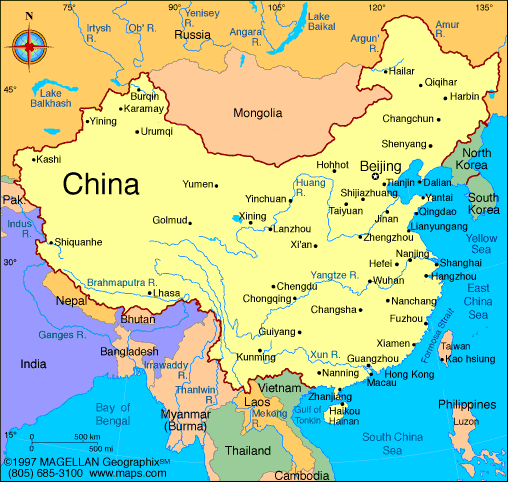
It's now five days until I leave for China.  I will be spending most of my time within what is called China's Golden Triangle - Xi'an, Beijing, and Shanghai. This 'triangle' is not only rich in history and culture but also representative of some of China's most modern cities.   Check out the map above, approximately how many miles will I travel if I go from Beijing to Xi'an to Shijiazhuang to Shanghai?  Click on this link to find out more facts about China's geography.

                                                                               China's Golden Triangle